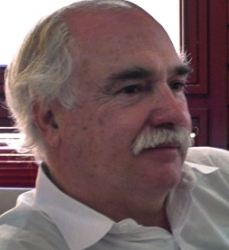
The most famous retirement in literature is a magician’s. The final act of The Tempest is an extended swan song not just for Propsero, but for the sorcerer who conjured him. When I first encountered the name Ricardo Sternberg, it was in the pages of Carmine Starnino’s seminal collection of essays A Lover’s Quarrel, and it was evident that some of Prospero’s rough magic was at work on the critic, a man who to many in the world of Canadian letters is something of a Caliban. At the time, Starnino went in for more conspicuously explosive language, bored of the lexically inert inheritors of Al Purdy. But Sternberg’s poems are less pyrotechnics than smoldering coals— which as it turns out is where the real heat is anyways. His poems are peopled by mermaids and angels, are visited by daemons and devils, and journey enchanted seas to imaginary islands. In other words, they charm.
Magic, by definition, is an exemption to the natural order, and the first thing readers notice and admire about Sternberg’s poems is the overwhelming sense that they shouldn’t work as well as they do. Their constituent parts are too simple; the language is that of everyday speech, sparingly multi-syllabic and rarely sending you to the dictionary. Faulkner once said something like that to Hemingway and intended it as an insult, but as Hemingway knew, it’s hard to cast a spell on someone whose nose is in the OED. And that’s just it: Sternberg’s poems operate the same way that spells do. He describes his own technique as “slowly blowing breath/ into each syllable,” and even here we can see the magic at work: the expertly weighted lines balanced by alternating alliteration, the bookending L sounds, the enjambment machine-tooled to correspond to the length of a breath. But what puts the lines over is that the mechanics of the artistry are hidden in the rafters, leaving only the illusion onstage. The sense is less that the magic has been muscled into place than that Sternberg has divined the secret connections between the words, unlocking their hypnotic qualities. As Quintilian said, “the perfection of art is to conceal art.” The effect is a feeling that the laws have been upended, of discovering that the magician’s coin has vanished from his hands and, abracadabra, appeared behind your ear.
We ask Sternberg the question we ask the magician: how did he do it? One of their tricks is that Sternberg’s poems do what Frost thought a good poem should: “Like a piece of ice on a hot stove,” Frost wrote, “the poem must ride on its own melting.” What does that mean? Like a spell (think of the spells of the witches of Macbeth, for example), the poem must be self-contained, self-actualizing, and self-consuming, enacting the recipe it mnemonically encodes, and using only its own materials for transportation. A perfect example is these lines of Sternberg’s, about a group of sailors lost at sea: “We sailed as we could:// now for the sake of sailing/ the silk sheen of the sea,/ its blue susurrus.” Listen to how the lines treadle themselves up and down as a ship does over a swell. And like its sailors venturing into the unknown without a map, the alliterative “s” sounds build toward the perfectly placed “susurrus,” a word that not only means, but sonically recreates, the inhuman babble of the open ocean. Like the entropic piece of ice, or a spell, the sense of the poem consumes itself at exactly the moment its power is fully realized.
In his review of Sterberg’s masterpiece of a second book, Map Of Dreams, Starnino characterizes the incantatory qualities of Sternberg’s verse as being consistent with prayer. This, I think, is untrue. Prayers, though they may share an origin with spells, operate in a fundamentally different way. Whereas spells are seductive, prayers are ingratiating; whereas spells are charming, prayers are obsequious. A prayer’s goal is grace, which is a god’s beneficence that’s bestowed despite the prayer. If a spell works, it’s only because its craftsmanship and delivery were unimpeachable. Spells have a materiality, an efficacy, an accountability that prayers lack, what Sternberg himself calls his “algebraic incantations.”
Most important of all though is that while the object of a prayer is an inscrutable god, whose reaction we can’t gauge, the object of a spell is the physical world, and often a human being. The magician, then, unlike the supplicant, can’t ever take his audience for granted. And unlike the petitioner, the magician knows when he’s failed. One of my favourite Sternberg poems, “The Alchemist,” from his debut The Invention of Honey, homes directly in on poetry as magic:
You will find
the laboratory
far simpler these days;
uncluttered.
The cauldron is gone,
the endless bubbling,
the stench, the maze
of pipes, the shelves
of exotic ingredients
that, however combined,
could not transmute
baseness into gold.
That is all done with.
Sold or given away
to whoever would have it.
The thin blue flame
went out.
But I have abandoned
more than tools.
The obstinate ideas
have been driven out
and I am now plagued
by something different
whose needs are simpler:
pen and paper and time
to apply one to the other.
There is no conjuring
but that which a pen
might drum
across the surface;
there is no incantation
but that which language
performs upon itself:
word linking with magic
word, the whole sustained
by the musculature of syntax.
Mystery is what remains
constant; mystery of magic
and of failure:
my nightmare of metal
forever dull,
replaced by this page
that remains blank
though I write upon it.
As far as I’m concerned, you can’t consider that poem a failure. But then why does the mystery of poetry remain constant? Why does Sternberg write, cryptically, that the page “remains blank/ though I write upon it”? Is the blank page the part of it that remains unwritten upon? No. The page remains blank even when it’s black with ink, because the true surface of the poem isn’t the page; it’s the person who’s reading it. Like a spell, the poem is inert until it’s cast on its intended target: you.
Like any magician worth his salt, Sternberg can conjure from thin air. In his poem “Onions,” he’s got voodoo for your Vidalia, writing: “The opacity of onions/ is deceiving.// The onion is a crystal ball/ that makes you cry/ for future sorrows.” In “Buffalo,” Sternberg is cheeky about his conjuring, writing, “I have wrestled a buffalo/ into this poem/ the least I could do/ for an endangered species.” And then, in a trick straight out of Inception, he writes, “the reader is to blame/ who brings red into this poem.”
But as everyone from David Copperfield to David Blaine knows, the crowds come for the disappearing acts. Like any top-hatted illusionist, Sternberg starts with birds. In “Oriole Weather,” he wonders if orioles fly the skies over his home. Later he writes, “But oriole, the word,/ flutters around me now/ as it has all week/ unaddressed/ until at last I write// south// and it goes.” Poof. But zooming out, and surveying Sternberg’s oeuvre as a whole, we can see that a grander, more fundamental disappearing act has been taking place beneath our noses. Beginning with his third book, Bamboo Church, magic itself, as a subject, was being transformed. In his first two books, The Invention of Honey, and Map of Dreams, the fantastical, by occupying the foreground of the poem, remained hypothetical. An early poem in Bamboo Church alerts us to the fact that by submerging magic in its particulars, he’s made it general. Here’s “Quark”:
Consider the quark: its existence
is posited by scientists entranced
by a nothing which is there;
a particle that does not share
the known properties of materiality:
there but not there: a ghost entity.
Cyril of Thessalonika argued the case:
God withdrew and thus freed space
for the expanding universe. Absence
was his gift which makes his presence
this oxymoron worthy of contemplation:
the Zero at the core of all creation.
Like Coleridge attending scientific lectures to replenish his stock of metaphors, by hitting the books, the purview of Sternberg’s sorcery has penetrated the natural world more deeply than ever before. And buried here in the irony of quantum mechanics—that at the centre of everything is nothing—is an even deeper irony: by becoming more secular, the God withdrawn, Sternberg’s poems became even more magical.
His best trick he saves for last: love. When a magician aims his gifts at our hearts, we call the voodoo charisma. I’m spelling it out here because as you may have noticed, Canadian writers are notoriously short on charisma, and maybe as a result, are famously unsuccessful as lovers. It’s not pretty; if someone isn’t getting a hook in the eye, then they’re staring a little too long and immodestly at a bear. Sternberg, unlike the rest of us, has moves. To my mind, he’s the best living poet of love in our country. Bookending his oeuvre are dances. His first book’s first poem, “The True Story of My Life,” is the dramatic monologue of a young prince being groomed for an arranged, aristocratic marriage. After lessons in “personal magnetism,” and dancing—most notably “the courtship dance”—the prince absconds with, and elopes, a commoner. In the final, title poem of his most recent book, “Some Dance,” we find the prince and his bride again, the poet and his wife, as they wash the dishes and dance in their kitchen. Across the distance between these two poems, we can trace Sternberg’s imaginative journey, from the mythical, enchanted beginnings to the secular magic of dancing in a darkened kitchen. Even there, the conjurer can wring a spell out of a hand towel: “You wash and rinse,/ I dry and stack.”
How does Sternberg do it? Here’s a thought. Magic, like love, and like poetry, is a contract. We furnish the conjurer, the poet, and the lover, with the raw material of our imagination, which is their quarry and their stage. We supply the lock in which their key is turned. Sternberg can transport us because he can look into us, deeper than did ever plummet sound, and see the imaginary islands to which we dream to travel—in poetry, in magic, and in love. The world conspires against all three. Today may begin his retirement, but in Ricardo Sternberg is a Prospero whose staff won’t break, whose books won’t drown.